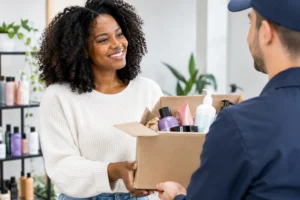
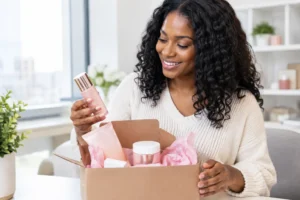
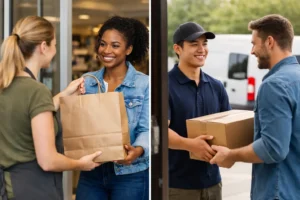
A retail delivery sales example is easiest to understand when the need is real: it is 5:30 p.m., a customer is getting ready for dinner at 7, and her edge control is empty. She does not need a package next week. She needs the right product from a nearby beauty store, delivered before the mirror, outfit, and plans are waiting on her.
That moment is where local delivery changes the sale. It turns a missed store visit into an order, an urgent restock into a better basket, and a neighborhood beauty supply store into a fast, mobile-first option for customers who do not have time for lines, traffic, or a last-minute run.
A Retail Delivery Sales Example: One Urgent Beauty Order
Here is an illustrative order from a participating local beauty supply store. The customer opens a delivery marketplace at 5:32 p.m. and searches for a few products she already knows she needs: edge control, braid spray, lashes, and lip gloss. While checking out, she adds a satin bonnet that catches her eye.
Her cart looks like this:
- Edge control: $8.99
- Braid spray: $12.99
- False lashes: $6.99
- Lip gloss: $7.99
- Satin bonnet: $7.54
The product subtotal is $44.50. A standard delivery fee is added at checkout, and the customer can choose priority delivery for an additional charge if the timeline is tight. Taxes and any applicable fees depend on the local market and order details.
For the store, that $44.50 is merchandise sales that may not have happened without delivery. The customer was not planning a shopping trip. She was planning to stay home, get ready, and solve the problem fast. Delivery puts the store’s inventory in the customer’s hand at the exact point of need.
Now assume, purely for planning purposes, that the marketplace fee on the merchandise subtotal is 12%. The fee on a $44.50 product order is $5.34, leaving $39.16 to the store before its own product costs, taxes, and fulfillment labor. The delivery charge is separate from the retail product sale and helps support the delivery service.
The real win is not only the first order. The customer found a nearby store with the products she wanted, avoided the drive, and got ready on time. If the products are correct, packed well, and delivered within the promised window, the next restock becomes easier. That is how convenience starts building repeat behavior.
Why Fast Delivery Can Increase the Basket
Urgency gets the customer to open the app. Smart merchandising gives her a reason to add more than one item. In the example above, the bonnet was not the emergency, but it fit the moment. That kind of add-on is natural when the selection feels curated and relevant.
Beauty is especially suited to this model because shoppers often buy in routines. A customer ordering mousse may also need wrapping strips. Someone grabbing beard oil may remember a brush, clippers guard, or wave cap. A last-minute makeup touch-up can lead to lashes, setting spray, and a matching lip color.
The goal is not to stuff the cart with random products. It is to make the next best item easy to find. Stores can support bigger baskets by keeping complementary products in stock, using clear product names and photos, and grouping staples around real use cases such as braid maintenance, barber appointments, date-night touch-ups, or travel-size restocks.
There is a trade-off. A huge digital catalog can make a store look well stocked, but it can also slow the customer down if search is messy or item details are unclear. Fast delivery only feels fast when the shopper can find the right shade, size, texture, or brand without guessing.
What the Store Could Earn at Daily Volume
One $44.50 order is useful. Consistent local demand is where the model gets more interesting.
Using the same illustrative average basket, a store that receives 10 delivery orders per day generates $445 in daily merchandise sales. Across 30 days, that is $13,350 in product sales processed through the marketplace. At the same example 12% marketplace fee, the store retains $11,748 before product costs and operating expenses.
Those numbers are not a promise. Results depend on location, assortment, pricing, delivery coverage, customer demand, store hours, marketplace terms, and whether the orders are truly incremental. Some orders may replace an in-store trip a customer would have made anyway. Others are brand-new sales created because the shopper could not, or would not, visit the store.
That distinction matters. A retailer should measure delivery sales alongside total store sales, not in a vacuum. If delivery orders rise while in-store sales hold steady, the store is likely reaching new demand. If digital customers repeatedly order category staples and add-ons, the channel may be building a more valuable customer relationship.
The Details That Make or Break the Order
A fast retail delivery experience has a simple promise: what the customer sees should be what arrives. That takes more than putting products online.
Inventory accuracy comes first. If the app says a specific 1B bundle, lace adhesive, or clipper blade is available, the store needs to confirm it quickly. Substitutions can save an order, but only when the customer approves them and the alternative is genuinely close. Sending the wrong shade or texture can turn a convenience win into a refund request.
Speed inside the store matters too. A team member needs a clear process to accept, pick, verify, and hand off orders. The best setup is practical: designated pickup space, packaging that protects liquids and fragile items, and a final check against the customer’s cart. A GlamRusher can move quickly, but the order has to be ready when they arrive.
Store hours also shape conversion. Beauty emergencies do not always happen at noon. Evening availability, weekend coverage, and accurate holiday hours can capture high-intent orders when customers are most likely to choose delivery over a store run.
How to Build a Better Beauty Delivery Assortment
Not every item belongs at the top of a delivery catalog. Start with products customers need now, recognize easily, and reorder often. Hair care staples, braiding supplies, barber essentials, lashes, adhesives, hair accessories, bonnets, makeup touch-up products, and travel-friendly beauty items all fit the urgent-commerce mindset.
Next, make hard-to-find inventory visible. A local store may carry a specific hair texture, premium styling product, professional-grade barber supply, or trend-driven accessory that big-box retailers do not stock. Those products can be powerful delivery drivers because the shopper already knows what she wants and does not want to spend the evening calling stores.
Then use pricing with intention. Delivery customers will pay for convenience when the value is clear, but they can compare prices fast. Keep product pricing consistent, communicate fees clearly, and give frequent shoppers a reason to consider a no-delivery-fee membership if one is available. The choice should feel simple: pay for a one-time rush or save across repeat orders.
For stores, platforms such as GlamRush2U offer a way to bring local inventory closer to customers without building a delivery fleet from scratch. The store still needs operational discipline, but it gains a new local storefront in the place customers already use to solve an immediate need.
Measure More Than Order Count
Order volume is a starting point, not the whole story. A beauty retailer should track average basket size, percentage of orders with add-ons, cancellation rate, substitution rate, order-ready time, repeat purchase rate, and the categories that drive the most urgent demand.
A lower-volume category with high repeat purchases may be more valuable than a viral item that creates one-time spikes. Likewise, a product that causes frequent substitutions may need better inventory controls or a clearer listing. The data should shape the assortment, not just report on it.
The strongest retail delivery sales example is not a flashy one-day spike. It is the customer who runs out of what she needs, opens the app without hesitation, finds the right product nearby, and knows she can keep getting ready while the order is on the way. Keep earning that kind of trust, one accurate, fast, beautifully packed order at a time.